Articles by "Animals"

3-4 minutes
No caption
Photo: Flikr
A new intelligence test involving Kea has confirmed what anyone who’s ever met one knows  - they’re clever – as clever as primates.
They’re engineers. They’re statisticians. They even predict the outcome of football matches.
But the kea is in trouble.
It’s hard to estimate how many live in the wild – they’re scattered widely and at low density across sprawling, forested areas – but our best guess puts the total wild population between 3,000 and 7,000 birds.
By comparison, there are more than 70,000 wild kiwi in New Zealand.
So, why is the alpine parrot disappearing?
North and South Journalist Michael White attended the Kea Conservation Trust’s annual conference late last year and says the reasons are many and varied.
“Early European settlers came here and put sheep on the land. The kea came along and would peck at the back of the sheep. That created a wound, and the sheep often died. So, farmers didn’t like them at all, and there was a bounty put on their head.
“You’d get a sizeable amount of money for bringing in a beak from a kea.”
After more than a hundred years, this policy was discontinued in the 1970s – but significant damage was already done: over 150,000 kea had been killed.
Now there are other, more modern threats  – largely stemming from the bird’s well-documented curiosity.
“A lot of old buildings up until the 1990s used lead nails, lead flashings … kea hang around on roofs and love playing with things.
“Because it’s soft, kea can twist it around in the mouths and their beaks, and they eat the lead – and it inevitably causes poisoning.
“It’s horrendous what it does … they either are affected so badly they lose their mobility and are hit by cars, or they actually die of the lead poisoning.”
But the main threat to kea these days is a familiar one: predators.
“Often, with a predator, when another species might think, ooh, a predator, I’ll run away … kea just decide they’ll investigate. They don’t run away.
“Their eggs can be eaten by stoats and rats. Possums or ferrets can actually take on a full-grown kea.”
So why is there so little awareness of the bird’s plight?
Part of the reason is market saturation.
According to the Department of Conservation, 70 species of bird are classified as vulnerable, endangered, or critical.
Michael White says this leads to jostling for space and airtime – a sort of conservation “hierarchy of need”.
“Everyone’s got their favourite species. But if you’re going to do a ranking based on [pure numbers] … that’s probably a realistic way of looking at it, but I think you have to look at it a bit more holistically.
“If you can help a species like the kea by controlling predators, inevitably you’re going to be helping a whole lot of other species as well.”
Join Geezgo for free. Use Geezgo's end-to-end encrypted Chat with your Closenets (friends, relatives, colleague etc) in personalized ways.>>

1-2 minutes

Heartbreaking footage of a monkey
A footage has emerged showing a mokey with a chain tied on it's neck, being forced by it's trainer to lift weights, dunk a basket ball and do sit-ups for tourists in Thailand.
The monkey named Ning Nang can be seen in the video released by Animal rights group, PETA Asia, lifting a mini barbell complete with weights above its head while it's trainer counts in English.
Acording to PETA Asia, teeths of monkeys are removed at young age, so they can be forced to perform activities without being able to bite back or defend themselves against a trainer.
Heartbreaking footage of a monkey
Jason Baker, a PETA Senior Vice President, said: "Videos like the one we've just released are helping to change public opinion.
“Forcing wild animals to perform is no longer the way to draw a crowd, but there's still much work to be done.
Heartbreaking footage of a monkey
"All travel companies need to stop promoting cruel shows and zoos, and tourists should stop buying tickets to them, opting instead to see animals in their natural habitats-the only place where they belong."
Heartbreaking footage of a monkey
Watch the video below.
Credit : PETA Asia
Join Geezgo for free. Use Geezgo's end-to-end encrypted Chat with your Closenets (friends, relatives, colleague etc) in personalized ways.>>

3 minutes
Cali Mayor's Office/AFP / Guillermo Gutiérrez / Alcaldia de Cali Twenty-year-old lion Jupiter does not have the strength to stand up after almost two years of being kept in dreadful conditions
Emaciated with a vacant gaze and without the strength to stand upright, 20-year-old lion Jupiter's life is in danger.
But authorities are acting to try to save him after he was discovered in a "critical state."
Leading attempts to restore Jupiter to full health is the woman who rescued him from the circus where he was born and brought him up as her "son" from the age of three months.
Ana Julia Torres has run the Villa Lorena animal sanctuary in Cali, Colombia for more than 30 years.
But in April 2019, environmental authorities confiscated Jupiter over a lack of required documentation and accusations that Torres was mistreating hundreds of wild animals, most of which arrived at her sanctuary showing signs of previous mistreatment.
When Jupiter was transferred to the Los Caimanes zoo in the department of Cordoba he weighed 250 kilograms (550 pounds), Torres said. Now his weight is down to just 90 kilos.
When the zoo closed he was taken to a nearby facility.
"Clearly he was locked up and that's when he started losing weight," said Torres, who claimed she had felt a mother's instinct that her progeny needed her help.
"He hasn't eaten for several days. It's a fact that an animal deteriorates" in such conditions, she said.
Dramatic pictures of Jupiter have gone viral on social media where a campaign was launched to help him.
Defense Minister Carlos Holmes Trujillo announced the lion would be sent home on an air force plane.
"This animal should never have left, nor been mistreated," said Cali's mayor Jorge Ivan Ospina.
He said local authorities were looking into building "appropriate" accommodation for Jupiter while the attorney general's office and police opened an animal cruelty enquiry.
Animal cruelty can be punished with up to three years in prison and a $12,000 fine.
Crucially, though, this king of the jungle -- who has never set foot in one -- is going home where his former carer is hoping to nurse him back to health.
"This love that he and I have for each other will save him," said Torres.
"That's the connection between a mother and a child."
Join Geezgo for free. Use Geezgo's end-to-end encrypted Chat with your Closenets (friends, relatives, colleague etc) in personalized ways.>>

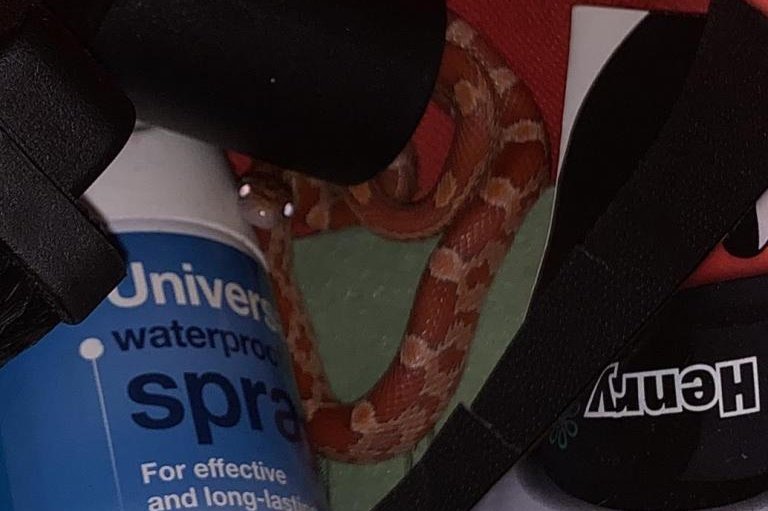
A London woman called animal rescuers when she discovered a snake under the vacuum in her cupboard. Photo courtesy of the RSPCA
By Ben Hooper A London woman looking for a pair of shoes in a cupboard inside her apartment found something far more startling -- a snake.
Kasia Radochonska, who lives in the Southwark area of London, said she was going through the cupboard Feb. 16 when she spotted a snake slithering from under her vacuum cleaner.
"I opened the cupboard in my flat where I keep my shoes and other bits and bobs," she said. "I looked at the vacuum cleaner and noticed something red, like rope. Then it moved and I thought: 'Oh my god, it's a snake!'"
Radochonska alerted the RSPCA, which sent animal collection officer Joe Tambini to the scene.
"Kasia had been knocking on doors in her block to find out if anyone was missing a snake but no one claimed her. She was a bit cold so I took her to RSPCA Putney Animal Hospital where she was put in a vivarium to heat up," Tambini said.
The corn snake, nicknamed Mavis, will be moved to an RSPCA rehoming center if no one comes forward to claim her as an escaped pet.
"People are always surprised to hear that we actually get called out to collect lots of escaped snakes who have gone wandering around the neighborhood. They can slither out of their vivariums and into strangers' homes; we've even had some hide for months before coming out later, much to the householder's shock," Tambini said.
Join Geezgo for free. Use Geezgo's end-to-end encrypted Chat with your Closenets (friends, relatives, colleague etc) in personalized ways.>>

2 minutes
A Pennsylvania family was reunited with their dog 28 hours after the toy poodle was carried off by a hawk.Image result for Dog reunited with Pennsylvania family after being stolen by hawk
Deborah Falcione of Whitehall, Allegheny County, said her 16-year-old dog, Porschia, who is deaf and blind, was snatched of the home's upper back deck Thursday.
Falcione said she gathered a group of friends and searched the area long into the night, but there were no signs of the toy poodle or the bird of prey who grabbed her.
"I was crying my eyes out. She is my life. My dogs are my life," Falcione told WTAE-TV.
Falcione said she was shocked to receive a call the next afternoon from Banfield Pet Hospital saying they had her dog.
"I said, 'That's impossible!' She could not have survived 28 hours out in the bitter cold weather, in 10-degree weather. This is a 6 1/2 pound dog. She's blind. She's deaf. She's 16 years old. I went down there, and sure enough, this is the dog. The old dog with the strongest will to survive," Falcione said.
The animal hospital said Porschia had been found by a neighbor about four blocks from her home. The dog was cold and lethargic, but didn't have any broken bones.
"How she got away, I'll have no idea. How she survived it, I will never know. But I know one thing: By the grace of God, this dog is still alive," Falcione said.
An 8-pound bichon frise named Zoey survived a similar ordeal in January 2018. Monica Newhard said Zoey was grabbed out of her Bowmanstown, Pa., yard by a swooping eagle.
The dog was found in a road about 4 miles from Newhard's home by a woman who took Zoey home and later spotted a Facebook post about the incident. Zoey was not seriously injured and was returned home a day after being carried away.
Join Geezgo for free. Use Geezgo's end-to-end encrypted Chat with your Closenets (friends, relatives, colleague etc) in personalized ways.>>

Even though the Buffalo Zoo was closed over the weekend after the Western New York city received nearly a foot of snow, one resident -- Sakari the polar bear -- felt right at home. The zoo posted a video of the 5-year-old polar bear exploring the snow Sunday in his habitat. He even went for a chilly dip in the pond. "While everyone is staying inside and keeping warm, Sakari thought it was a perfect day to roll around in the snow and go for a swim! Ahhh the life of a polar bear!" the zoo said in a Twitter post. Sakari can be seen sliding down a small slope in his enclosure, rolling around in the snow and shaking it off. Sakari came to the Buffalo Zoo from the Henry Vilas Zoo in Madison, Wis., in January 2017. Zoo officials expect him to weigh 750 pounds to 1,200 pounds once he becomes fully grown. Buffalo received a foot of snow in some areas Saturday amid a winter storm that paralyzed much of the Northeast and Midwest.
Join Geezgo for free. Use Geezgo's end-to-end encrypted Chat with your Closenets (friends, relatives, colleague etc) in personalized ways.>>

Underestimating a penguin is a mistake that might cost you dearly Penguins have an undeserved reputation as funny and somewhat ridiculous animals and it’s easy to see why: they’re cute, flightless birds that waddle about like fluffy, drunk toddlers. Hollywood casts Danny Devito as your human equivalent for a reason. However, underestimating them is a mistake that might cost you dearly, as one petrel bird discovered when it attacked a group of emperor penguin chicks hoping for an easy meal. Penguin chicks face giant petrel As these chicks made their way to the sea without their parents’ supervision for the first time, a predatory giant petrel swooped in for what it thought would prove a quick kill. The chicks initially tried to flee, but struggled with running on land, and, in a case of ironically unhappy feet, one of them slipped and fell, becoming an easy prey to the predatory bird. When the petrel grabbed him by the neck with its strong beak, it looked like there was little or no hope left for the clumsy chick, but a tactical fall allowed it to escape and slide away back to its group. Rejoined by their fallen companion, the chicks assembled into a defensive circle that allowed them to protect each other from all sides. The hunt was brought to a stall. After a tense stand off, the arrival of an adult adelie, a smaller, but extremely feisty species of penguin, finally set the petrel on the run. Predators like the petrel are just one of the many dangers encountered daily by penguins. What strategies do they adopt to survive in one of the most inhospitable environment in the world? STRENGTH IN NUMBERS Strength in numbers is the most known survival strategy for penguins. Huddling together allows them to find shelter from the extreme cold and unforgiving snow storms, but also functions as protection to fight off some of the many, deadly predators that inhabit Antarctica.Image used on the post COUNTERSHADING Disguise is another fundamental skill for the survival of penguins. Their typical black and white coat is more than just a fabulous look: the colour arrangement provides penguins with counter-shading, a method of camouflage used by many animals where their top colour is much darker than their underside. In the case of penguins, it allows them to stay hidden from both predators and preys when in the sea: their white belly blends them with the bright sea surface, while the black feathers make them disappear into the dark bottom of the ocean. Fashionable AND practical! TOBOGGANING Penguin bellies are not just useful for camouflage: when on land, they are also the tools that provide them with their fastest escape technique, tobogganing, the word that better describes when penguins slide on their belly to gain speed on ice. Curiously, Penguins have been observed tobogganing not only to escape predators or move faster, but also just for fun. JUMPING There’s another, amazing technique Penguins use to escape predators, and that’s jumping out of water up to nine feet straight. For small, flightless birds, that seems like an incredible feat, and Penguins achieve it by trapping air bubbles under their plumage before diving. When they then release these air-bubbles as they swim towards the surface, the air coats their bodies like a lubricant, allowing them to achieve the great speed that lets them go airborne once outside the water. These are only some of penguins’ surprising skills. Discover more of their unexpected survival secrets below. https://www.geezgo.com/sps/52454 Join Geezgo for free. Use Geezgo's end-to-end encrypted Chat with your Closenets (friends, relatives, colleague etc) in personalized ways.>>

Underestimating a penguin is a mistake that might cost you dearly

Penguins have an undeserved reputation as funny and somewhat ridiculous animals and it’s easy to see why: they’re cute, flightless birds that waddle about like fluffy, drunk toddlers. Hollywood casts Danny Devito as your human equivalent for a reason.

However, underestimating them is a mistake that might cost you dearly, as one petrel bird discovered when it attacked a group of emperor penguin chicks hoping for an easy meal.
Penguin chicks face giant petrel

As these chicks made their way to the sea without their parents’ supervision for the first time, a predatory giant petrel swooped in for what it thought would prove a quick kill. The chicks initially tried to flee, but struggled with running on land, and, in a case of ironically unhappy feet, one of them slipped and fell, becoming an easy prey to the predatory bird.

When the petrel grabbed him by the neck with its strong beak, it looked like there was little or no hope left for the clumsy chick, but a tactical fall allowed it to escape and slide away back to its group.

Rejoined by their fallen companion, the chicks assembled into a defensive circle that allowed them to protect each other from all sides. The hunt was brought to a stall. After a tense stand off, the arrival of an adult adelie, a smaller, but extremely feisty species of penguin, finally set the petrel on the run.

Predators like the petrel are just one of the many dangers encountered daily by penguins.

What strategies do they adopt to survive in one of the most inhospitable environment in the world?
STRENGTH IN NUMBERS

Strength in numbers is the most known survival strategy for penguins. Huddling together allows them to find shelter from the extreme cold and unforgiving snow storms, but also functions as protection to fight off some of the many, deadly predators that inhabit Antarctica.
COUNTERSHADING

Disguise is another fundamental skill for the survival of penguins. Their typical black and white coat is more than just a fabulous look: the colour arrangement provides penguins with counter-shading, a method of camouflage used by many animals where their top colour is much darker than their underside. In the case of penguins, it allows them to stay hidden from both predators and preys when in the sea: their white belly blends them with the bright sea surface, while the black feathers make them disappear into the dark bottom of the ocean. Fashionable AND practical!
TOBOGGANING

Penguin bellies are not just useful for camouflage: when on land, they are also the tools that provide them with their fastest escape technique, tobogganing, the word that better describes when penguins slide on their belly to gain speed on ice. Curiously, Penguins have been observed tobogganing not only to escape predators or move faster, but also just for fun.
JUMPING

There’s another, amazing technique Penguins use to escape predators, and that’s jumping out of water up to nine feet straight. For small, flightless birds, that seems like an incredible feat, and Penguins achieve it by trapping air bubbles under their plumage before diving. When they then release these air-bubbles as they swim towards the surface, the air coats their bodies like a lubricant, allowing them to achieve the great speed that lets them go airborne once outside the water.

These are only some of penguins’ surprising skills. Discover more of their unexpected survival secrets below.
https://www.geezgo.com/sps/52454

Join Geezgo for free. Use Geezgo's end-to-end encrypted Chat with your Closenets (friends, relatives, colleague etc) in personalized ways.>>

The West Coast Penguin Trust is worried birds could die during a bumper beech forest cycle this year.

The Department of Conservation is putting a plan in place to deal with what was expected to be a mega mast year, in which heavy beech seeding produces an abundance of food for rats, mice and stoats.

Even though the penguins' breeding season does not start until July, the trust is beginning preparations for the mega mast.

The group's manager, Inger Perkins, said they were concerned the event could hamper the breeding success of Fiordland crested and blue penguins.

She said there was a similar event in 2016 and the consequences were disastrous.

She told RNZ: "In one site where we had 10 cameras I think in every single nest the eggs or the chicks were taken by stouts, so something was clearly different and we believe it was because of a beech mast nearby."

The West Coast Penguin Trust set out to reverse the decline of blue penguins in 2006, but it quickly recognised the need to extend its conservation work to both penguins in the region, as well as other threatened seabirds.

The Fiordland crested penguin, or tawaki, is just one level removed from the highest level of threat status in New Zealand at "nationally endangered". Blue Penguins are a few levels further down, being "at risk - declining".

https://www.geezgo.com/sps/51963

Join Geezgo for free. Use Geezgo's end-to-end encrypted Chat with your Closenets (friends, relatives, colleague etc) in personalized ways.>>

Move aside cheetah and peregrine falcon, there is a new contender for the title of fastest animal on Earth: the Dracula ant. Scientists have discovered that the small tropical insect can snap its mandibles at up to 90 metres a second (more than 200mph), the fastest animal movement on record.

The ants use the explosive motion to attack, stun and kill prey, which is then fed to their larvae.


“They’re cruising around underground and if they encounter something like a centipede or a termite they can smack them with the mandibles to kill or stun them,” said Andrew Suarez, an animal biology professor at the University of Illinois, who led the work. “They can then sting it to further incapacitate it and then they carry it back to the nest.”

The species, Mystrium camillae, was already known to have highly specialised appendages. However, scientists were able to ascertain the exact speed of the snapping motion only with the advent of high-speed video technology over the past 10 years. The scientists also used x-ray imaging technology to observe the ants’ anatomy in three dimensions to better understand how the movement works.

The observations showed that Dracula ants power up their mandibles by pressing the tips together, spring-loading them with internal stresses. Eventually, when one mandible slides across the other, each is released, in a similar motion to people clicking their fingers.

The Dracula ant’s motion is different from that seen in trap-jaw ants, which were previously considered to have the world’s fastest snapping jaws. Those ants start from an open position and suddenly snap shut like a mousetrap.
“Even among ants that power-amplify their jaws, the Dracula ants are unique,” said Adrian Smith, of the North

Carolina Museum of Natural Sciences, who was a co-author of the study. “Instead of using three different parts for the spring, latch and lever arm, all three are combined in the mandible.”

Dracula ants are mostly found in the tropics in Africa and Asia. They live in large colonies underground, or inside tree trunks, so are rarely seen. Their name derives from their unusual feeding habits, which involves a form of non-destructive cannibalism. The adult ants are unable to process solid food; instead, they feed prey to their larvae and then chew holes in the larvae and drink their blood. Scientists call the arrangement a “social stomach”.

In future the team plan to make more detailed observations of the ants in action in their natural environment. “Their biology, how they capture prey and defend their nests, is still in need of description,” Smith said.

The findings are published in the journal Royal Society Open Science.

Join Geezgo for free. Use Geezgo's end-to-end encrypted Chat with your Closenets (friends, relatives, colleague etc) in personalized ways.>>

Geezwild

Contact Form

Name

Email *

Message *

Powered by Blogger.
Javascript DisablePlease Enable Javascript To See All Widget