For
tennis enthusiasts, the number of luxury hotels that truly accommodate
their passion for the sport is low. Many of the best resorts may offer
court access and lessons with a pro, but that’s usually the extent of
what’s available. Thankfully, there are properties that prioritize
tennis as a highlight of their programming, providing guests ample
opportunity to build their schedules around the tennis court with a
variety of related activities that will not only improve their games
but also put them in touch with like-minded travelers. Here are some of
the best.
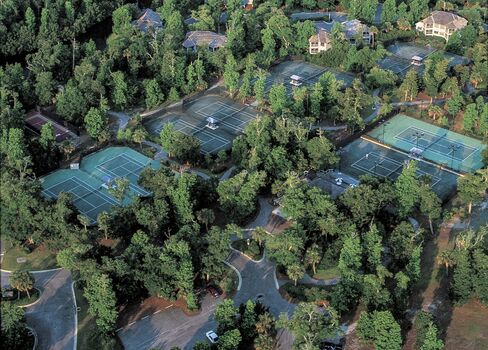
Aerial image of one of Kiawah Island Golf Resort's tennis facilities.
This resort has two tennis facilities, one of which is the Roy Barth
Tennis Center in East Beach. Barth, who was one of the founding members
of the ATP Tour, usually makes the rounds during clinics to offer
invaluable tips on how to improve your game. There are stroke-a-day
clinics, private lessons, and doubles camps with Barth himself, all of
which can be preceded by an always helpful early-morning stretching
session. Combined, the resort oversees 24 tennis courts—one is a
practice court outfitted with an automated ball retrieval system in case
the tennis center can’t match guests. When to Go: Mild weather here means you can go year-round. Rates: rooms from $545; court fees, $36/hour; lessons from $33.
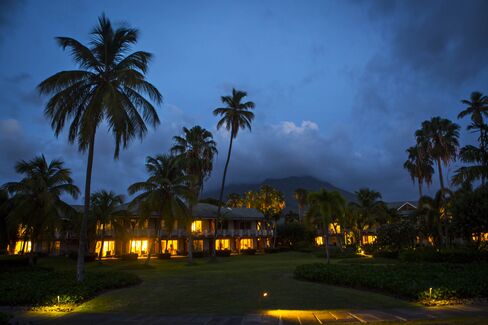
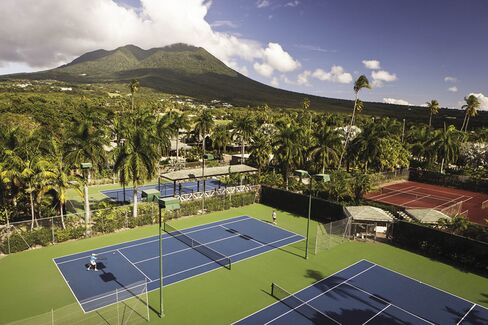
The six hard courts—one with bleachers—and four red-clay
courts (with views of Nevis Peak) are used for clinics, game matching,
private lessons, and a weekly round-robin tournament. All this is
overseen by the world’s top tennis management team, called Peter Burwash
International (PBI), which brings the highest standards to tennis
programs all over the world. But to keep things social, the Caribbean
resort also hosts a tennis happy hour, when guests can combine practice
with boozy drinks. When to Go: There are no indoor courts, but Nevis’s generally mild weather makes it a good year-round destination for tennis. Rates: rooms from $385; court fees, from $35/hour; one-on-one sessions, from $65/hour.
This Waldorf Astoria resort’s tennis center is complete with
30 clay-based courts, including 18 Hydro-Grid and 12 Har-Tru courts,
and a fully stocked pro shop, as well as a tennis concierge to assist in
planning guests’ tennis vacations. But its most impressive amenity
right now is its partnership with legendary racqueteer Jimmy Connors.
A three-night package has a lot of perks—such as a private airport
transfer in a Maserati Quattroporte, couples' massages, and an intimate
Morimoto dinner—but none will top the half-day tennis lesson that
Connors will administer. When to Go: Any time but summer is great for tennis in Florida. Rates: rooms from $420; private lessons, from $125/hour; Ultimate Experience package starting at $23,875.
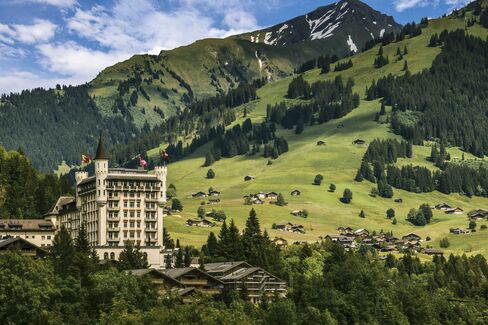
Beautiful views of the Swiss Alps can be seen at Gstaad Palace.
The four outdoor clay courts here are stunningly surrounded
by the Alps, which explains why the hotel is still a popular haunt for
celebrities, including tennis great Roy Emerson, who organizes several
weeklong camps during the summer, which includes 25 hours of lessons. In
August, Olympic champion Marc Rosset will open his own own camp, this
time for kids. There are three indoor courts, too, minus the views. When to Go: Gstaad Palace is open only in winter and summer. Rates: rooms from $420; court fees $30/hour; lessons from $105/hour; camps from $2,200.
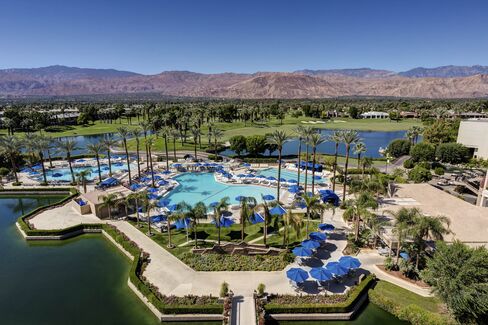
After tennis, you can hit the pool at the JW Marriott Desert Springs
Tennis diehards will love the variety of surfaces on offer
at this Palm Desert resort: 15 hard, three clay, and two grass courts,
immaculately kept. (Because of the kind of maintenance involved, natural
grass courts are a rare treat.) PBI-led, workout-based drills, clinics,
lessons, and a fantastic round-robin tournament that plays on all three
surfaces are available. Come during the Indian Wells tournament and
spot the world’s best. When to Go: Summer in the desert can be blazing hot, but the rest of the year offers enjoyable temperature for daily tennis. Rates: suites
from $450; court fees include an hour of court use every day, but
additional time runs at $32/hour; semi-private lessons, $35/hour.
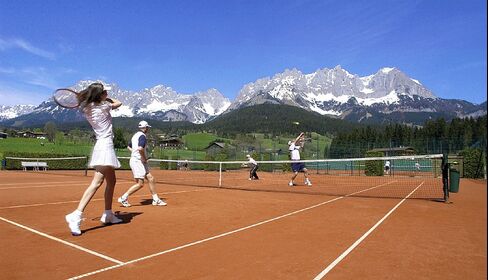
One of the eight outdoor courts at the Bio-Hotel Stanglwirt.
With dramatic views of the Wilder Kaisers mountains in the
backdrop, a hour and a half west of Salzburg, the eight outdoor courts
of this Tirolean resort are pretty special. But the programing (PBI,
naturally) is top-notch, too. For lessons, the student-pro ratio never
dips below 4:1 so you know you’ll be getting personalized attention.
Every November, Stanglwirt organizes a four-day master tournament
round-robin for top guests and camp participants. And when ATP-level
tournament in nearby Kitzbühel comes around, the resort hosts a one-day
event that brings some of the players over to mingle with guests. When to Go: Whenever you want—there are six indoor courts, too. Rates: studio rooms from $415; court fees, $15/hour; lessons, from $70.
During the ATP and WTA off seasons in December,
these all-outdoor courts become popular training grounds for big-name
players and their entourages. (Andy Murray was here last year.) For the
rest of us, there’s a weekly roster of activities, from round-robin
tournaments, to themed clinics, to private lessons. PBI also organizes a
weeklong, intensive tennis camp (four hours on the court every day for
five days). When to Go: In winter, when temperatures are at their mildest. Rates: rooms from $430; court use is complimentary to hotel guests; lessons, from $100; PBI camp, from $2,700 including lodging.
An indoor clinic at Thanyapura Sports & Leisure Club.
In northern Phuket, surrounded by Thailand's lush tropical
vegetation, this six-court tennis complex offers a more exotic setting
for a dazzling rally. Morning clinics, social tennis, cardio sessions,
several annual tournaments, and weeklong immersive programs are offered
to adults, but the children’s activities are equally robust. There’s a
junior academy, intensive coaching programs, and later this year, a
clinic with former ATP doubles players Sonchat and Sonchai Ratiwatana. When to Go: With four indoor courts, you can visit year-round, but November to February is the mildest season for outdoor play. Costs: suites from $230; private lessons, from $52.
Camp in luxury on the American Prairie Reserve, an
ambitious project to turn 3.5 million acres of Montana back over to the
animals that once ruled the Plains.
“If you listen closely, you can tell their tones apart,” says Daniel
Wendell, a private chef and, for the moment, our color commentator on a
late summer’s elk rut on the Great Plains of Montana. From an overlook
in the Charles M. Russell National Wildlife Refuge, my wife, Mary, and I
have been following the action through binoculars and a telescope. In
between his analysis, Wendell and his team set a table—linen, china,
cloth napkins, wineglasses, wildflower arrangements—for an evening
picnic.
Downslope on a tawny cottonwood-studded meadow, five or six
elk bulls move among several dozen cows and bugle their mating call. To
my untrained ear, they all sound about the same—the louder and more
frequent, apparently, the better a bull’s chances to expand his harem.
But for such immense beasts, some of their tones are awfully squeaky,
like a pennywhistle dropped into a pail. Let’s Get It On sung not by Marvin Gaye, but Alvin and the Chipmunks.
What we’re really hoping for, naturally, is a fight. As Wendell
plates our first course of baby kale tossed with tomatoes, Wagyu bacon,
and tamari-toasted buckwheat, another of our hosts, Alison Fox, calls
our attention to one particularly restive bull. He pulls up alongside
another, and at first they take a little walk together. Then, right as
it seems they might wrap things up—“good talk, man”—they back up, square
off, and charge.
A sponge cake dessert served at the elk refuge.
Even from our distance, we can hear the clack of their
racks colliding and the grunting trash talk that follows as they push
each other around. “There’s more where that came from, buddy,” Wendell
translates. The challenger relents, and we turn to our appetizers, which
are followed by a meal of sous vide rib-eye loin with golden yams in a
horseradish crème and, for dessert, sponge cake with whipped ricotta,
peaches, and edible marigolds and nasturtiums.
We’ve come to Montana to explore the American Prairie Reserve,
an ambitious project that reflects a sea change in how land and
wildlife conservation is practiced. Whereas most U.S. national parks’
boundaries are based on the attractions people wanted to visit, the APR
is drawn from the range and migratory patterns of plants and animals, so
that native species, including the endangered black ferret and
long-gone brown bear, can recover and return.
Founded as a nonprofit in 2001, the APR has raised about
$80 million, all from private donations. Some are from high-profile
philanthropists such as Susan Packard Orr, daughter of the co-founder of
Hewlett-Packard, or the heirs to the Mars candy fortune. Smaller
contributions have come in the public radio $10-per-month range. That
funding has been used to buy and lease some 307,000 acres to fill in the
gaps between existing federally protected areas such as the Russell
Refuge and Upper Missouri River Breaks National Monument. Right now, the
APR is a patchwork of parcels that don’t yet form a single park.
Eventually the reserve will spare the plow on 3.5 million contiguous
acres—an area the size of Connecticut that stretches east from the
Missouri Breaks to Fort Peck Lake in central northeastern Montana.
One way to think of the APR’s approach is as an American
take on the African safari. (An early National Geographic documentary on
the project is called American Serengeti, a phrase the reserve
eagerly promotes.) African safaris hype the “Big Five”—lion, leopard,
elephant, rhino, Cape buffalo. So far, the APR reliably delivers a “Big
Two,” 800 head of American buffalo, aka bison, and those elk we spy on
during our picnic.
The reserve seeks to include other native species such as mountain
lion, wolf, fox, bighorn sheep, and brown bear. “We tend to think of
grizzlies as creatures of the mountains,” says Fox, the APR’s
thirtysomething managing director, “but that’s only because they’ve been
forced to hole up in the Rockies or parks like Yellowstone. They used
to run the Plains.”
“The sky will be your ocean.”
For the past 15 years, the reserve has been working to put itself on
the map with Yellowstone and the region’s other better-known
attractions, the Grand Tetons and Glacier National Park. It may not have
an Old Faithful, but it does have Kestrel Camp,
a handful of luxurious yurts that opened in 2013 to entertain donors
and tourists willing to spend $4,800 for a two-person, two-night stay,
during which they’ll be well-fed by Wendell, who came into his own
following a stint at Chez Panisse.
We finish our picnic and take the two-hour drive to camp. As we
emerge from our dust-choked and bug-splattered rig, we’re treated to a
breathtaking array of Northern Lights. These aren’t the green-curtain
Aurora Borealis familiar from pictures taken in Alaska or Scandinavia;
they’re more like the opening-gala searchlight edition, a half-dozen
shimmering ribbons of color combing the Milky Way.
Kestrel Camp, a small collection of luxury yurts on the Montana prairie.
One other advantage to arriving in the dark:
You wake up the next day to discover just what you’ve gotten yourself
into. At Kestrel, this reveal is made more dramatic by the way the
sunlight pours like a bore tide across the Plains, a time-lapse
photographer’s dream landscape.
We brew up a pot of the Ghost Town coffee provided in the yurt and
sit on the deck, steam rising from our mugs, the last of our travel
stress melting away. Some years ago, I’d moved to the high desert in New
Mexico and worried I’d miss living near a body of water. A hippie did
his best to reassure me: “Dude, the sky will be your ocean.” I’d
laughed, but he wasn’t wrong. That mind-clearing horizon is here in
Montana, too.
As in the desert, prairie mornings start chilly but warm up fast.
We’d arrived at the tail end of summer, so we wear lightweight puffs for
the short walk to the communal yurt for breakfast. Afterward, we peel
them in a slight sweat. The unofficial APR look is a fleece tied around
your waist, sun hat, and zinc for your nose. It’s a place of blazing sun
and goosebump-raising breezes, for short sleeves and a wool hat at the
same time.
The interior of a safari-style yurt at Kestrel Camp.
We pile into a Mercedes Sprinter van to begin our safari. A guide,
Ellen Anderson, takes us to a prairie dog town, where we hear the
industrious buggers clicking to each other. At the Enrico Education
& Science Center, a 7,000-square-foot modern building, we meet a few
summer interns. One young woman sitting with a pad and watercolors
paints a still life, which looks like a great way to spend a few hours
out here.
It turns out to be a splendid day for wildlife peeping. We see
coyote, mule deer, pronghorn antelope, sage grouse, and a meadowlark.
But the bison are the draw. At one point, a dozen or more surround the
Sprinter, and a few slam their massive bodies to the ground just a few
yards away for a dust bath. They roll back and forth like happy
dogs—really, really big happy dogs. Although they don’t have the royal
bearing of a lion or the gawky swing of a giraffe, they’re captivating
to watch, even when they aren’t up to much. They seem so top- and
front-heavy, I keep waiting for one to tip forward and face-plant.
Wendell indulges us with another exquisite meal at the dining room
yurt that evening. (The sauvignon blanc and trout stand out.) We end the
night around a fire pit with the other guests, including two longtime
APR board members, Gib and Susan Myers. They’re both retired; Gib was a
partner at the Mayfield Fund, a Menlo Park, Calif., venture capital
firm, and Susan helped produce documentary films. Everyone proves fine
company, but at the end of another long day, and with a neat High West
bourbon in hand, it’s tempting to drift from the conversation and just
stare at all those stars.
The explorers Lewis and Clark stopped near
here on April 22, 1805. “I ascended to the top of the cut bluff this
morning,” Meriwether Lewis wrote in his journal that day, 11 months into
their 28-month, 8,000-mile trip from St. Louis to the Pacific and back
to explore the Louisiana Purchase territories. “I had a most delightful
view of the country, the whole of which, except the valley formed by the
Missouri, is void of timber or underbrush, exposing to the first glance
of the spectator immense herds of buffalo, elk, deer, and antelope
feeding in one common and boundless pasture.”
Unwinding by the fire after dinner.
At that time, two skilled hunters could provide all 200 members of
the Lewis and Clark team with 8 to 10 pounds of meat per man—a literal
ton of meat each day. Broadly speaking, the APR wants to bring back the
plenitude Lewis described.
“We looked all over, at all the last remaining grassland
regions, the Yukon, Alberta, and Saskatchewan,” says Dr. Curt Freese, a
conservation biologist who partnered with the World Wildlife Fund and
other private groups on this reserve in 2000. He’s also developed an
index—the Freese Scale—to help land managers balance agricultural
production and ecological vitality. “Here in Montana, we found the
largest areas of intact land, the highest concentration of biodiversity,
and the lowest [human] population density.”
On the third day of our visit, I’m invited to join a group
making a “transect,” or crossing, of reserve land by foot and mountain
bike. Even though it means giving up the splendor of the yurt for a cot
in a canvas tent, I jump at the chance. Some of the trails are single
tracks, much of it’s fire road, but it all makes for a decent morning’s
ride. From my bike perch, I take in some spectacularly weird places I
might have otherwise missed.
We move through several distinct terrains: juniper and
ponderosa on knolls similar to the Black Hills of South Dakota; a steppe
that reminds me of ones I’ve seen in Nevada; and stretches of
calf-high, waving grasses and sagebrush. I feel like a bit of a
poser—most of the group I’m with have been rolling for 13 days so far.
But then we crest a hill with the sky so high it feels less like cycling
and more like flying.
On the ride, I get to chat with Sean Gerrity, the APR’s
57-year-old president. Given the populist moment we’re in, it’s not
surprising that the reserve is controversial. “Don’t Buffalo Us” signs
stud a few roads leading in and out of reserve property. Gerrity speaks
freely, if carefully, about the friction. The crux of the conflict, he
says, is buffalo vs. cattle. Restoring the natural order of things on
the prairie makes cattle appear, as they are, an invasive species.
Cowboys don’t take kindly to the notion of anyone telling them how to
be, and exaggerated fears about bison as vectors of disease abound as
well.
The view of a trail used to cross the reserve.
Gerrity says the reserve isn’t pushing anyone out or threatening
anyone’s livelihood—or livestock. “We only buy land from willing
buyers,” he says. The reserve has created a for-profit brand, Wild Sky,
to sell grass-fed beef from area ranchers at regional supermarkets as an
added incentive to help them tolerate wildlife on their property
instead of hunting and killing it.
Although Mary and I did miss the comfort of the yurt (even
the clever moth that figured out how to trip the motion sensor on the
night light), the transect wasn’t roughing it too badly. The part that
was hardest to get used to was something I hadn’t expected: the wind.
Almost all day, every day on the prairie it blew. Even when there was no
other sound, it was always loud. At times, the wind roared like a
standing ovation at a stadium; at others, inside the yurt, it thrummed
like soft rain or radio static. Then, when it did stop, a deep silence
took hold, like a black hole had eaten all the noise in the world.
Take a tour of stunning Zanzibar, a place of
crystal-blue water and striking white beaches, fragrant spice farms, and
an array of new five-star resorts.
By Andrew Parks | April 21, 2016
Photographs by Adrian Gaut
From
Zanzibar, the small collection of islands 23 miles off the coast of
Tanzania, wears its influences well. At the center of the spice trade
for centuries, the archipelago has been occupied by Swahili tribes,
Indian settlers, and European colonialists, but none left as indelible a
mark as the sultans from the Arabian Peninsula. Their lavish mansions,
baths, and forts are centered primarily in Stone Town, the largest city
on the island of Unguja and a Unesco World Heritage Site.
The “majestic spice island” of the Indian Ocean is
regaining its status as a high-end destination. Zanzibar’s airport
completed a renovation in December to accommodate more direct flights
from Dubai, Frankfurt, Johannesburg, and Rome. The palaces are being
converted into luxury retreats: Last year, Park Hyatt restored Mambo Msiige, a 17th century mansion that takes up several blocks of the city’s waterfront. Five-star boutique Per Aquum,
a luxury brand from the Maldives, is taking over a resort in Nungwi on
the northernmost tip of Unguja. Nearby, fishermen catch fresh marlin,
octopus, and tuna every morning, and dhow makers repair boats before
returning them to the sea. The past and the future are never far apart
in this mostly Muslim country, where calls to prayer echo over the
sapphire-blue water, mingling with the clink of cocktail glasses along
chalky-white beaches. We sent renowned photographer Adrian Gaut to
capture Zanzibar’s dazzling mix of old and new.
A view of the welcome center at Essque Zalu Zanzibar at night.
The Old Dispensary, with its elegant layout and ornate,
cross-cultural mix of Indian, Arab, and neoclassical architectural
influences, is one of the most striking buildings in Stone Town. On the
second floor, an oceanside hookah bar called the Three Bees serves about
70 varieties of shisha tobacco.
Dhow makers work on Nungwi Beach.
Hamamni Persian Baths, the first public baths in Stone Town, built by Sultan Barghash bin Said in the late 19th century.
Indian-inspired balconies in Stone Town.
Dried lemon peels to be used as part of a “Singo” body
scrub, the traditional beauty regimen local women undergo weeks before
their wedding.
An arch of the Anglican Christ Church Cathedral in Stone Town, built on the former site of Zanzibar’s largest slave market.
Muslim women in brightly colored hijabs on Nungwi Beach.
Every door in Stone Town tells a story, especially the
hand-carved history lessons that line Baghani Street and the
labyrinthine lanes of the Shangani district. There are two primary
types: Indian doors, also known as Gujarati, which have square shutters,
brass knobs, and intricate images of animals. And Arab doors, which are
often rectangular or semicircular and brim with baroque patterns and
inscriptions of key passages from the Quran. Symbolic details such as
fish scales and vines, chains, and beads signify the social status of
the owner behind each entryway.