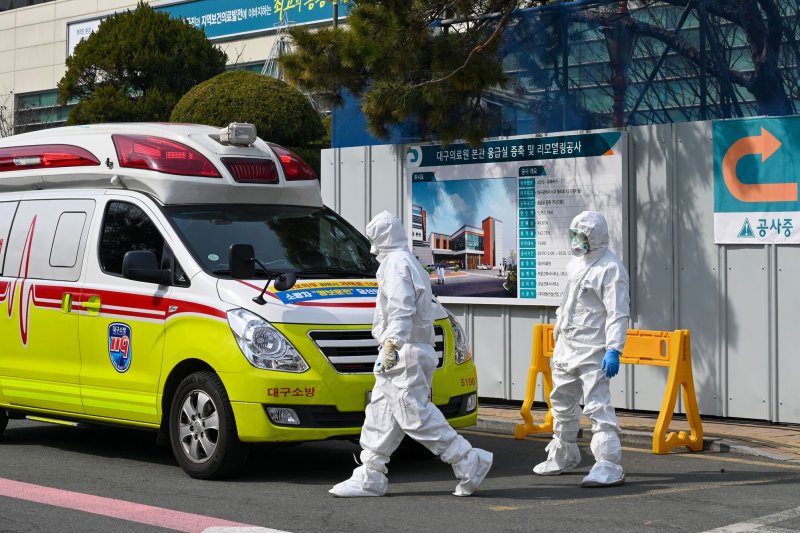
A downward trend in new coronavirus cases in South Korea
raised hope on Tuesday that Asia’s biggest outbreak outside China may be
slowing, but officials urged vigilance with new clusters of infections
emerging in a call center and a dance class.
The
Korea Centers for Disease Control and Prevention (KCDC) reported 35 new
coronavirus cases, down from a peak of 909 on Feb. 29. The new figures
brought the national tally to 7,513, while the death toll rose by three
to 54.
The numbers are expected to be updated later on Tuesday.
The
fall in the daily tally of new infections to its lowest level in 11
days coincided with the completion of testing of most of the roughly
200,000 followers of a fringe Christian church at the center of South
Korea’s epidemic.
Yoon Tae-ho, director general for public health
policy at the health ministry, urged businesses to do what they could
to help stem the outbreak after the discovery of 64 new cases among
call-centre workers and their relatives.
“The rate of increase is declining but there are still many new cases,” Yoon told a briefing.
“We
need to pay attention to crowded workplaces including call centers. The
cooperation of business owners is essential as they shouldn’t let
employees come in if they show symptoms like fever.”
More than
90% of South Korea’s cases have been in the southeastern city of Daegu,
where the church at the center of the outbreak is based, and the nearby
province of North Gyeongsang.
But alarm has been raised in the
capital, Seoul, with the new cases there linked to the call-center,
operated by an insurance company.
Authorities are investigating
in the cluster and say more infections are likely among the 200 people
packed into the floor where the call-center is located. They are being
tested.
Seoul’s mayor, Park Won-soon, told a briefing the call-center outbreak was the capital’s largest.
“We will urgently check companies where many people work in the same space like call centres,” Park said.
More than 90 out of 102 cases in the central province of South Chungcheong have been traced to a Zumba dance class.
Among
the infections linked to the class were three government officials,
including one from the health ministry, triggering extensive
disinfection efforts at the buildings where they work.
The U.S.
military in south Korea reported a new case on Tuesday, a Korean worker
at a base in Daegu. That took the total number of infections to nine
among soldiers, employees or people related to the roughly 28,500 U.S.
troops stationed in South Korea.
President Moon Jae-in has
expressed guarded hope for the fight against the virus, saying the
downward trend in new infections could lead to a phase of stability, but
he warned that it was too early for optimism.
South
Korean President Moon Jae-in on Wednesday canceled his planned trip to
the UAE, Egypt and Turkey in mid-March, over coronavirus, according to
the presidential Blue House. “In response to the recent
nationwide spread of COVID-19, we have decided not to go ahead with
trips,” said presidential blue house spokesman Kang Min-seok in a
statement.
South Korea reported 516 new coronavirus cases on Wednesday, raising the country’s total tally to 5,328.
South
Korean soldiers in protective gears sanitize shacks as a luxury
high-rise apartment complex is seen in the background at Guryong village
in Seoul, South Korea, March 3, 2020. REUTERS/Heo Ran
SEOUL
(Reuters) - South Korea reported 516 new coronavirus cases on Wednesday
as thousands of sick people waited for hospital beds in Daegu, the city
at the center of the worst outbreak outside mainland China.
The
new cases bring South Korea’s total to 5,328, with at least 32 deaths,
mostly in and around Daegu where the flu-like virus has spread rapidly
through members of a fringe Christian group.
“We need special
measures in times of emergency,” South Korean Prime Minister Chung
Sye-kyun said during a special cabinet meeting.
“In order to
overcome COVID-19 as quickly as possible and minimize the impact on the
economy, it is necessary to proactively inject all available resources.”
COVID-19 is the illness caused by the new coronavirus which
emerged from central China late last year and has spread around the
world.
Hospitals in South Korea’s hardest hit areas were scrambling to accommodate the surge in new patients.
In
Daegu, 2,300 people were waiting to be admitted to hospitals and
temporary medical facilities, Vice Health Minister Kim Gang-lip said.
A
100-bed military hospital that had been handling many of the most
serious cases was due to have 200 additional beds available by Thursday,
he added.
South Korean President Moon Jae-in on Tuesday declared
“war” on the virus, apologized for shortages of face masks and promised
support for virus-hit small businesses in Asia’s fourth-biggest
economy.
South Korea’s president declared war on the coronavirus
on Tuesday, ordering additional hospital beds and more face masks to be
made available as the number of cases rose by 974 in the worst epidemic
of any nation outside China.
South
Korean soldiers in protective gears sanitize shacks at Guryong village
in Seoul, South Korea, March 3, 2020. REUTERS/Heo Ran
President
Moon Jae-in apologized for shortages of face masks and promised support
for virus-hit small businesses in Asia’s fourth-biggest economy, which
has now reported 5,186 cases of the flu-like disease and 34 deaths.
“The
entire country has entered war against the infectious disease as the
crisis in Daegu and Gyeongbuk province has reached the highest point,”
he told a cabinet meeting, referring to the hardest-hit parts of the
country.
“I am very sorry to the people that we are not able to supply masks swiftly and sufficiently, and have caused inconvenience.”
The
virus which originated in China late last year began to spread rapidly
in South Korea after it entered the congregation of a Christian sect in
Daegu city, the Shincheonji Church of Jesus.
Daegu’s mayor told
reporters he had asked the president for 3,000 more hospital rooms to
cope with the rising number of the coronavirus patients.
The
leader of the sect and self-proclaimed messiah Lee Man-hee tested
negative for the virus on Monday, having been threatened with arrest
unless he agreed to be examined.
He had earlier apologized for the sect’s role in spreading the virus and called the epidemic a “great calamity”.
The
church and Lee personally have come under intense scrutiny and growing
public anger, and some politicians have reported them for prosecution.
BATTLE FOR MASKS
President
Moon ordered masks to be stockpiled as a strategic item so suppliers
can increase output without fear of producing surplus.
There
have been long queues outside retail stores and online suppliers have
been selling out as soon as stock arrives, even though the World Health
Organization says healthy people only need to wear masks if they are
caring for someone who is sick.
Lee Ji-eun, a 34-year-old doctor
in Seoul, said her daily routine began with surfing the internet to try
to find masks for her family.
“It is totally a lottery. I click
‘buy’ like crazy every morning, but I only succeeded in purchasing a few
last week,” she said. “There aren’t enough even for doctors when
treating patients.”
In Daegu, people on Tuesday were lining up at
pharmacies to buy masks distributed by the government. A man was caught
lining up to buy a mask after testing positive for the virus, a police
official told Reuters.
North Korea
state media said Monday South Koreans are being discriminated against
in the wake of the escalating number of confirmed cases of COVID-19 in the country.
Pyongyang propaganda service Meari said in a statement the world is
"rejecting South Korean nationals" as Seoul struggles to contain the
virus. Confirmed cases in the South rose to 4,335 on Monday.
North Korea has stayed quiet on the issue of the coronavirus outbreak
following the declaration of a national emergency in January. The
regime has claimed it has "zero" confirmed cases, but international
experts have said the lack of adequate medical facilities mean the
country is unprepared to deal with the virus.
On Monday, Meari said the number of deaths related to COVID-19 is on
the rise in the South. As a result, the world is rejecting South Korean
travelers, and the turning down of South Koreans at international
borders is becoming "extreme," Meari claimed.
North Korea state media did not say travel restrictions apply to all
travelers originating from South Korea, regardless of nationality. Meari
also said more than 62 countries have imposed bans or stepped up immigration
restrictions as of Friday. The statement was not updated to reflect the
latest data; more than 80 countries had some restrictions for travelers
from South Korea by Monday.
The propaganda service also suggested the South was being perceived as a dangero
The overwhelming majority of working women in South Korea
say they have experienced some form of gender discrimination, including
sexual harassment and wage discrimination, according to a local survey.
Bae Jin-kyung of the Korean Women Workers Association said Monday the
survey of 404 South Korean women that took place from Jan. 16 to Feb.
25 indicate most respondents, or 74 percent, experience some form of
discrimination.
Respondents said they are victims of a gender wage gap; 54 percent
said they have been unable to break free of low pay, and 53.5 percent of
the surveyed people said they receive lower salaries than men who
perform the same work, according to South Korean news service Oh My
News.
South Korean news service Voice of the People reported KWWA has staged protests against wage discrimination in February.
Discrimination against women may begin before their term of
employment, according to the survey. About 46 percent of respondents
said they were treated differently as women in the hiring process; about
44 percent said they were regarded less highly because they were not
the male head of their households.
Respondents also said they are the target of biased language.
Honorifics, used commonly in South Korea in the professional work
environment, are applied less to women than men in the office, the
survey shows.
Honorifics, usually mandatory for a younger man or woman when
addressing their senior colleagues, are not being applied to women, one
respondent said.
"While honorifics are used to address men at work, they are not when
I'm being spoken to," one respondent said, according to KWWA. The source
also said younger men did not use honorifics to address her and
sometimes even used curse words.
Women are also expected to beautify themselves and wear makeup at all
times. Women who do not wear makeup are derided as "looking ill" at her
workplace, one survey respondent said.
Expectations about women and the presentation of their femininity or
visual appeal may contribute to workplace sexual harassment, Bae said.
North
Korean leader Kim Jong Un attends a drill by a unit of the Korean
People's Army (KPA), North Korea in this image released by North Korea's
Korean Central News Agency (KCNA) on February 29, 2020. KCNA via
REUTERS
SEOUL (Reuters) - North
Korean leader Kim Jong Un oversaw military drills on Friday, state
media KCNA said on Saturday, a rare public outing amid efforts to
prevent an outbreak of the coronavirus in the isolated country.
North
Korea has not confirmed any cases of the virus, but state media said a
month-long quarantine period had been imposed for people showing
symptoms and “high-intensity” measures were taken including reinforcing
checks in border regions and at airports and sea ports.
On Feb.
16, Kim made his first public appearance in 22 days to visit a mausoleum
marking the anniversary of the birth of his father and late leader Kim
Jong Il.
The military drill was to “judge the mobility and the
fire power strike ability” on the frontline and eastern units and ended
to a “great satisfaction” of Kim, KCNA said.
“Soldiers, who have
firmly armed themselves with a-match-for-a-hundred idea of the Party
and trained under the simulated conditions of actual battles, reduced a
target islet to a sea of flames,” KCNA said.
In a separate
dispatch, KCNA said Kim has also convened a meeting of the ruling
Workers’ Party’s powerful politburo where a stricter enforcement of
“top-class anti-epidemic steps” was discussed to prevent the spread of
the virus.
“In case the infectious disease spreading beyond
control finds its way into our country, it will entail serious
consequences,” Kim was quoted as telling the meeting. “No special cases
must be allowed within the state anti-epidemic system.”
He
instructed the officials to “seal off all the channels and space through
which the infectious disease may find its way, and strengthen check-up,
test and quarantine,” KCNA added.
FILE PHOTO: A Charles Schwab sign is pictured in the Manhattan borough of New York, October 10, 2015. REUTERS/Eduardo Munoz
NEW YORK (Reuters) - Brokerage giant Charles Schwab Corp (SCHW.N) has asked employees who recently traveled to China or South Korea to remain at home for the next two weeks.
The request came via email on Friday morning to the firm’s 20,000 global employees, a Schwab spokesman said.
“Our
primary concern is the health and safety of our employees and we are
providing tips and resources to help them reduce any risk of exposure,”
the company said in a statement to Reuters.
Both China and South
Korea are currently on the U.S. Centers for Disease Control and
Prevention warning level 3, at which point the government agency
suggests avoiding all non-essential travel. Schwab’s self-quarantine
policies will expand to include any other countries that are added to
the warning level 3 category, the firm said.
Iran, Italy and
Japan are currently on the CDC’s alert level 2, which suggests that
older adults and those with chronic medical conditions should consider
postponing non-essential travel. Hong Kong, Singapore, Thailand and
Taiwan are also on the CDC’s watch list for possible spread of
coronavirus, now known as COVID-19.
Schwab, which manages total
client assets of $4.04 trillion, services its Chinese clients through
its Hong Kong office and its European clients out of an office in
London.
Schwab’s shares fell 2.7% on Friday while the broad S&P 500 fell 0.8%.
The coronavirus was first identified in the Chinese city of Wuhan on Dec. 31 of last year.
Fears
of the rapidly spreading virus have rattled global financial markets
this week after new cases were found in Italy, Nigeria and South Korea.
Energy, airlines and hotel stocks have led U.S. equities lower in
anticipation that the outbreak will lead to severe cutbacks in business
and vacation travel.
Cases of COVID-19 spiked again in South Korea on Monday,
with 277 new patients reported by the Korean Centers for Disease Control
and Prevention, raising the country's total to 833.
The death toll for the infectious disease, caused by the new
coronavirus that originated in Wuhan, China, rose to seven, with two new
cases reported on Monday.
The majority of patients are centered in the southeastern city of
Daegu and its surrounding areas, with roughly 60 percent of cases
clustered around a secretive church and 15 percent more connected to a
hospital in neighboring Cheongdo county.
On Sunday, South Korea raised its virus alert system to "red," its highest level, with President Moon Jae-in
saying the COVID-19 outbreak has reached a "grave turning point" and
warning that the next few days would be crucial in combating the spread
of the illness.
South Korea now has the second-highest number of cases in the world outside China.
On Monday, Vice Health and Welfare Minister Kim Gang-lip warned that
if the COVID-19 outbreak is not contained within Daegu, South Korea's
fourth-largest city, it could soon spread around the country of 51
million people.
"If authorities fail to contain the spread of the COVID-19 in Daegu,
there is a high possibility that COVID-19 could spread nationwide," he
told reporters, according to South Korean news agency Yonhap.
Health officials will test some 28,000 Daegu residents who are exhibiting flu-like symptoms, Kim said.
Workers are also screening around 9,000 followers of the Shincheonji Church of Jesus, where a 61-year-old woman who is considered a "super-spreader" of the virus attended services before and after exhibiting symptoms.
Health officials advised the woman to be tested at least twice after
coming down with symptoms, health authorities said, but she refused
until finally feeling sick enough to check into a clinic for the test
Feb. 17. She was confirmed as South Korea's 31st COVID-19 patient on
Tuesday.
In an online announcement Sunday, the Shincheonji church said it has
shut down its 1,100 churches and buildings nationwide and canceled all
services and meetings. On its website, the church also denied criticism
that it has not been fully cooperating with health authorities.
However, many observers say the church's secretive nature and
mistrust of outsiders likely played a role in the spread of the disease.
"Members are drilled to lie about membership and activities," Peter
Daley, a Seoul-based researcher on Korean cults, told UPI, adding that
large gatherings with close personal contact are the norm for the
group's services.
Authorities said Sunday they are still attempting to track down around 600 church members who have not been reachable.
Public backlash has grown against the Shincheonji church, with an online petition
on the presidential Blue House website demanding that government
forcibly dissolve the sect receiving over 550,000 signatures by Monday
evening.
The KCDC announced Monday new COVID-19 prevention guidelines in accordance with the heightened alert level.
In a statement, the KCDC said pregnant women, senior citizens and
those with chronic illnesses should avoid crowded areas and wear masks
when outside or visiting medical institutions. It also advised that
those with fevers or respiratory symptoms to refrain from going to
school or work.
Nationwide, school holidays have been extended due to the crisis and
many large-scale gatherings are being canceled. A session at the
country's National Assembly was called off on Monday after a
COVID-19-infected patient was found to have participated at an event in
the building last week.
Seoul's city government has also stepped up efforts to contain the
spread of the disease in the nation's capital, staggering work schedules
for municipal employees, increasing inspections and banning rallies at
three large public squares.
A group of thousands of conservative Christian activists who
regularly hold demonstrations against Moon defied the ban on Saturday,
however. Moon on Monday called the COVID-19 outbreak an "unusual
emergency" and said at a briefing with aides that the government may
need to release a supplementary budget to help ward off the economic
fallout from the outbreak.
"The government should make special prescriptions for extraordinary economic times," he said.
FILE
PHOTO: U.S. President Donald Trump shakes hands with North Korean
leader Kim Jong Un as they meet at the demilitarized zone separating the
two Koreas, in Panmunjom, South Korea, June 30, 2019. KCNA via REUTERS
GENEVA
(Reuters) - South Korea’s foreign minister called on Monday for a quick
resumption of stalled U.S.-North Korean nuclear talks, adding that her
government stood ready to engage with Pyongyang to facilitate dialogue.
Kang
Kyung-wha, addressing the U.N.-sponsored Conference on Disarmament,
said the goal remained complete denuclearisation on the divided Korean
peninsula.
“A speedy resumption of the U.S.-DPRK negotiations is
critical so that all stakeholders maintain and build upon the hard-won
momentum for dialogue. We stand ready to engage with the North in a way
that facilitates and accelerates the U.S.-DPRK dialogue,” Kang told the
Geneva forum.
South Korea was promoting projects with the
Democratic People’s Republic of Korea, she said, using the formal name
of the isolated country.
“And we will do so adhering faithfully to the international sanctions regime on the DPRK,” Kang added.
North
Korea has been subjected to U.N. sanctions since 2006. They have been
strengthened by the Security Council over the years in a bid to cut off
funding for Pyongyang’s nuclear and ballistic missile programs.
North
Korea continued to enhance its nuclear and ballistic missile programs
last year in breach of United Nations sanctions, according to a
confidential U.N. report seen by Reuters in New York this month.
North
Korea told the Geneva talks last month that as the United States had
ignored its year-end deadline for nuclear talks, it no longer felt bound
by commitments, which included a halt to its nuclear testing and the
firing of inter-continental ballistic missiles.
There was no immediate reaction from the North Korean or U.S. delegations on Monday as the meeting continued.
SEOUL: North Korea has decided to deport a U.S. citizen detained since October, state news agency KCNA said on Friday.
The American, whom the agency identified as Bruce Byron Lowrance,
"illegally" entered North Korea from China and told his captors he was
"under the control of the CIA", it said.
South Korea's unification minister left Seoul late Tuesday for
Washington, where he is expected to meet with U.S. Secretary of State
Mike Pompeo, South Korean press reported.
Cho Myoung-gyon, who has had extensive contact with top North Korean
officials in 2018, is meeting with key politicians in the Trump
administration and visiting think tanks, the JoongAng Ilbo reported.
The anticipated meeting between Cho and Pompeo is an unusual move,
analysts told the South Korean newspaper. Pompeo's counterpart in Seoul
is Foreign Minister Kang Kyung-hwa.
Jeong Se-hyun, a former unification minister, said it is "unprecedented"
for Seoul's unification ministry to deal directly with the U.S. State
Department.
RELATED Report: China bans North Korea financial transactions
"In this situation where the United States is putting the brakes on
U.S.-North Korea relations, there is a need for the unification ministry
to directly persuade the U.S. State Department," Jeong said.
Other analysts said the task is not easy, according to the report.
Cho is traveling to the United States a day after the Center for
Strategic and International Studies published a report that stated a
North Korean missile base is active as of November.
The report, and claims of North Korean "deception" in a New York Times article, drew a critical response from Seoul.
On Tuesday President Donald Trump dismissed the report in a tweet.
"The story in the New York Times concerning North Korea developing
missile bases is inaccurate. We fully know about the sites being
discussed, nothing new -- and nothing happening out of the normal. Just
more Fake News. I will be the first to let you know if things go bad!"
Trump tweeted.
Center for Strategic and International Studies analysts said the
Sakkanmol base is a "forward Hwasong-5/-6 missile-operating base
subordinate to the Strategic Force of the Korean People's Army."


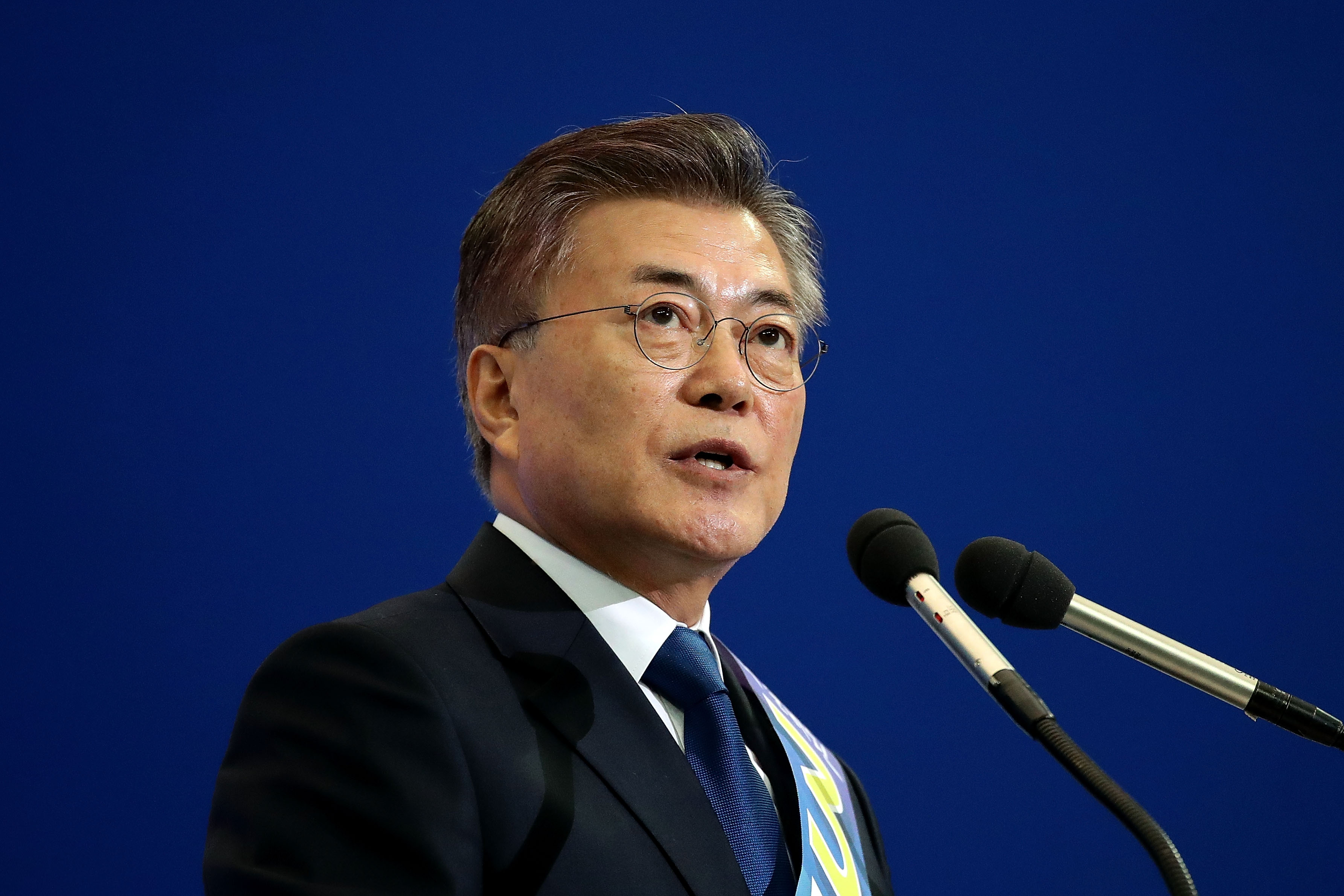 South
Korean President Moon Jae-in on Wednesday canceled his planned trip to
the UAE, Egypt and Turkey in mid-March, over coronavirus, according to
the presidential Blue House. “In response to the recent
nationwide spread of COVID-19, we have decided not to go ahead with
trips,” said presidential blue house spokesman Kang Min-seok in a
statement.
South
Korean President Moon Jae-in on Wednesday canceled his planned trip to
the UAE, Egypt and Turkey in mid-March, over coronavirus, according to
the presidential Blue House. “In response to the recent
nationwide spread of COVID-19, we have decided not to go ahead with
trips,” said presidential blue house spokesman Kang Min-seok in a
statement.