
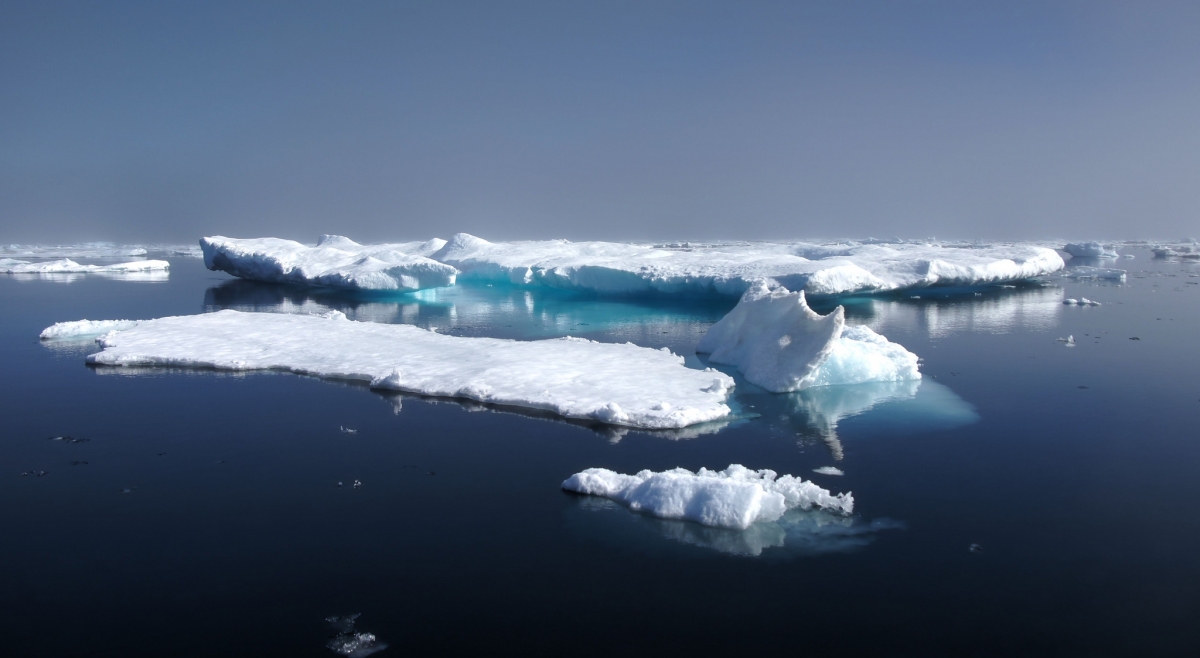
The Arctic was ice-free between six and ten million years ago
mariusz kluzniak/Flickr
The central Arctic was completely ice-free during the summer
months, six to ten million years ago. Research shows parts of the North
Pole had sea surface temperatures of up to 9°C.
The study, published in Nature Communications,
sheds light on a relatively unknown time period for the Arctic. The
discovery will also help scientists to generate more accurate future
climate models.
The researchers, from the Alfred Wegener Institute, made the
discovery after a 2014 expedition to the Lomonosov Ridge, Central
Arctic. They wanted to analyse the history of the North Pole by using
long sediment samples. They managed to excavate 18 sediment cores up to
eight metres long.
"With the help of certain microfossils – so-called
dinoflagellates – we were able to unambiguously establish that the lower
part of this core consists of approximately six to eight
million-year-old sediments," said Ruediger Stein, lead author of the
study. They then used 'climate indicators' to establish the cover of sea
ice in each time period along the sediment core.
These climate indicators include a type of aquatic algae
that requires light to exist. If sea ice was present, the water
underneath would be pitch black, as no light would get through. However,
the sediment cores show the algae between six and ten million years
ago, indicating that the Central Arctic was completely ice-free during
that time.
Not only that, but this algae generates different compounds
dependent on water temperature. The researchers used this information to
discover the approximate temperature of the Arctic Ocean, up to ten
million years ago; between four and nine degrees Celsius.
The scientists say that this is just the first step in
uncovering the history of the North Pole's sea ice. They say that in
order to fully understand historic Arctic climate, they need to study
data from up to 60 million years ago. They have planned an Arctic
drilling expedition for 2018, where they hope to uncover sediment cores
detailing this piece of history.
Post a Comment