
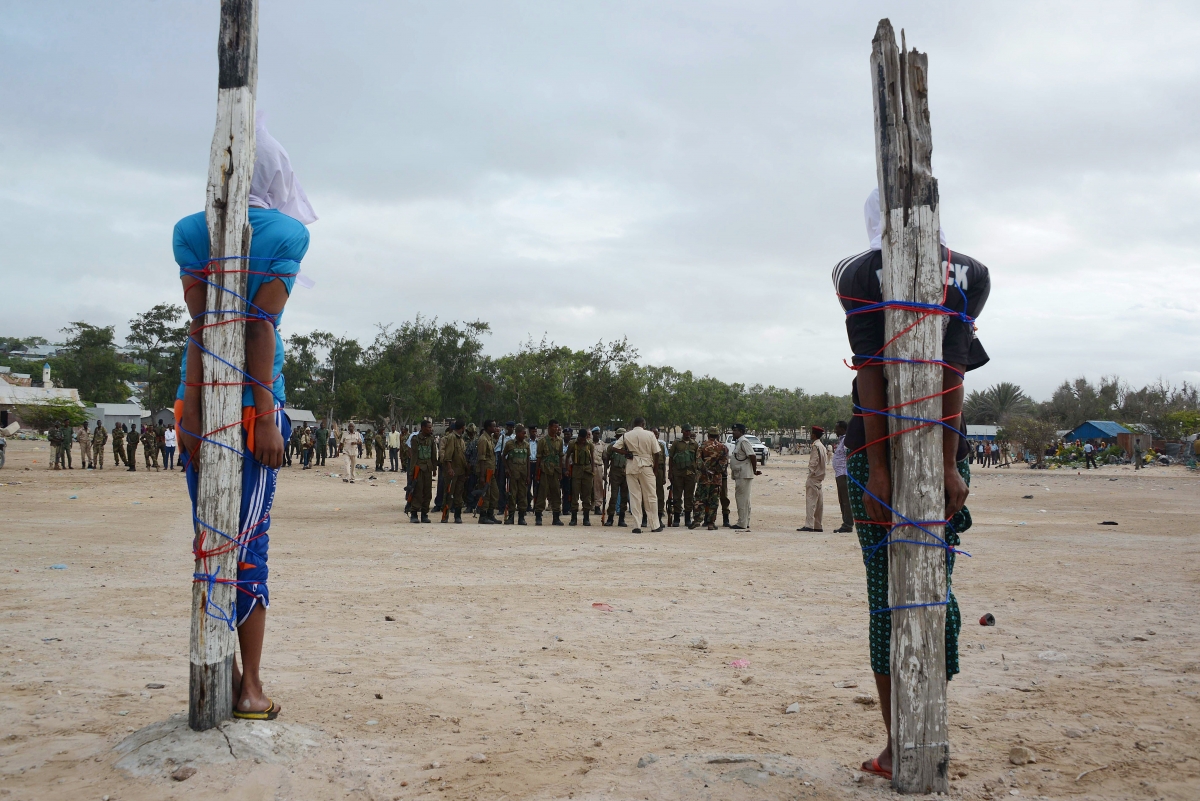
Two Somalis are tied to large wooden stakes as they wait to be executed by a firing squad on 15 July 2014 in Mogadishu
Mohamed Abdiwahab/Getty
A "profoundly disturbing" surge in the number of executions
in 2015 saw at least 1,634 people killed globally, according to a new
report from human rights group Amnesty International. The figure does
not account for China, "where thousands were likely to have been
executed but where the death penalty is a state secret."
The top five executioners in the world in 2015 were named as China, Iran, Pakistan, Saudi Arabia and the US.
At least 977 people were killed by Iran last year – up 31% from 2014 –
mostly for drug-related crimes. The report also shamed the country as
one of the last remaining places on Earth where death sentences against
child offenders are carried out. Four people who were under the age of
18 when they committed the crime were put to death last year in Iran.
Amnesty also recorded its highest ever number for Pakistan,
which sent at least 320 people to the gallows last year. Saudi Arabia
also saw a sharp rise in the number of executions
(158) with a 76% increase on 2014. Methods included beheadings and
firing squads and corpses were publicly displayed on occasions.
"The rise in executions last year is profoundly disturbing,"
said Salil Shetty, Amnesty International's Secretary General, in a
statement. "Not for the last 25 years have so many people been put to
death by states around the world.
"Iran, Pakistan and Saudi Arabia have all put people to
death at unprecedented levels, often after grossly unfair trials. This
slaughter must end," Shetty added.
After a decade-long hiatus, Chad resumed its use of the
death penalty with the execution of 10 people. Figures from Amnesty
International put the global death row population at a minimum of 20,292
people.
Although the UK formally opposes the death penalty, the
government has been accused of putting its trade relations with
countries with poor human rights records first. "Like the Foreign
Affairs Committee yesterday, we're worried that the Government has
started soft-pedalling over foreign countries' use of the death penalty,
preferring to prioritise trade with countries like China, Saudi Arabia
or Pakistan," said Kate Allen, Amnesty International's UK director.
"Until recently the UK's policy of seeking global abolition
of capital punishment had a clear focus and strategy. Now the death
penalty's been thrown into the pot with other concerns and it's much
harder to tell whether the Government is prioritising this
life-and-death matter.
"If governments in Beijing, Tehran, Islamabad and Riyadh
aren't hearing about our outrage at executions after torture and unfair
trials, then the executioners are going to think they've got a green
light to carry on killing," added Allen. "We want to see the Foreign
Office publishing a clear strategy for its anti-death penalty work at
the earliest opportunity."
Britain rolled out the red carpet for Chinese President Xi
Jinping during a state visit in October last year despite public concern
over Beijing's questionable human rights record.
Earlier this week, MPs warned that there is an increasing perception
that human rights has been downgraded to a less important issue in order
to prioritise trade.
Post a Comment