
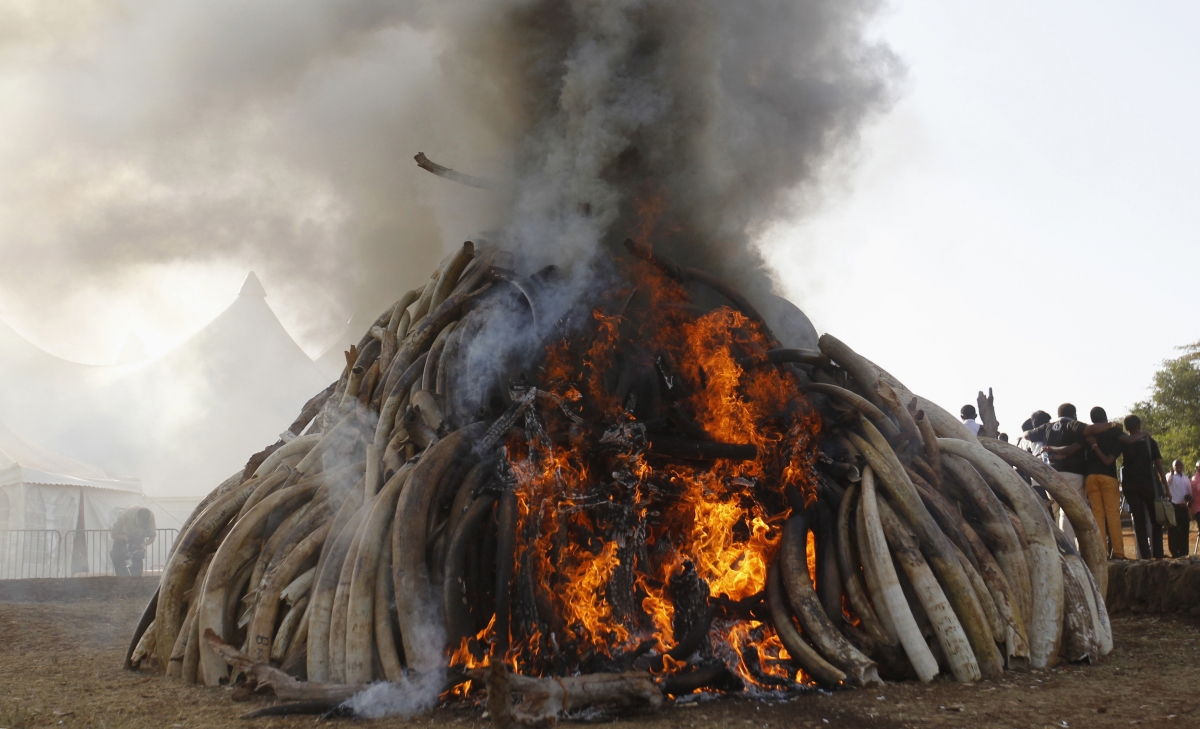
Fifteen
tonnes of ivory confiscated from smugglers and poachers is burnt to
mark World Wildlife Day at the Nairobi National Park March 3, 2015
Reuters
President Kenyatta is convening the Giants Club Summit in a
zero-tolerance bid to stamp out the illegal ivory trade, culminating in
the burning of 120 tonnes of ivory on 30 April. Eight African heads of
state have been invited and they will be joined by leaders of Africa's
largest companies as well as conservation experts. The ivory bonfire at
the Nairobi National Park is the largest amount of ivory ever destroyed by any country.
Peter Knights, CEO for WildAid will be at the summit to
speak on the importance of celebrities to raise awareness of
anti-poaching initiatives. Crucial to the campaign is Yao Ming, the 7'
6" basketball player from China who took part in a documentary about
illegal ivory trading.
The NBA star is immensely popular in China and Knights
believes that the End Of The Wild is the only documentary that has been
screened on mainstream TV in China. "We believe there is a 50% increase
in awareness about ivory poaching in China due to our campaigns," says
Knights. Other celebrities to have helped in anti-poaching campaigns
include Prince William, David Beckham, Yao Ming and Jackie Chan.
Public opinion is also turning the tide against ivory poaching
although Knights warns: "Elephants in West Africa may become extinct
pretty rapidly as well as in Central Africa, with the decimation of East
African herds."
The latest celebrity to promote the campaign as a cause
celebre is Oscar-winning actress Lupita Nyong'o, who is probably the
best-known Kenyan star on the international stage. She is taking part in
the Poaching Steals From Us All campaign initiated by African Wildlife
Foundation (AWF) and WildAid.
A lucrative industry
At the bottom of the food chain are the poachers who are essentially risking their lives and in many cases there have been violent skirmishes between armed poachers and soldiers. But despite the dangers the financial lure continues to prove irresistible. One kilogramme of ivory is worth between $1,000 - $1,500 on the Asian market, and just one tusk can be worth around £40,000 once it is carved into decorative items.
"Our feeling is that the poachers are not the ones to blame.
They are the petty criminals, many of whom may be quite poor," says
Knights. "The blame needs to go to the profiteers, the middlemen and
ultimately the consumers because if the consumers don't buy the ivory,
the middlemen won't make money."
Poachers pass the ivory
to middlemen who are often locals and also to Chinese business people.
One high profile case involved a Chinese national, Yang Feng Glan, who
was a long-term resident in Tanzania. The woman, dubbed the Ivory Queen,
was accused of smuggling 706 elephant tusks worth £1.62m from Tanzania
to China and the Far East. Glan was described by campaign group The Elephant Action League as "the most important ivory trafficker ever arrested in the country".
Anti-poaching
campaigns also aim to show how elephants are killed through various
methods including stoning them to death; shooting with AK 47s or even
with old muskets. Poisoned arrows are also used, which is a slow and
excruciatingly painful death for the animal. "It's not usually one shot
that kills them, explains Knights. "There's quite a lot of elephants
walking around with up to 6 or 7 bullet wounds which haven't killed them
outright."
Putting an end to the illegal ivory trade
One of the aims of the Giants Club Summit founded by President Kenyatta together with the presidents of Botswana, Gabon, Kenya and Uganda, was to look at anti-poaching solutions and how they can be implemented."The lubricant of the ivory trade particularly in ports like Mombasa and Dar es Salaam
are
undoubtedly officials who are being bribed to let stuff through. It's
not a cause but it's definitely an enabler," says Knights.
"What hasn't worked is just relying on law enforcement. What I think
is successful is where you back up law enforcement with stronger laws
and penalties. Increase the intelligence gathering – get inside and
infiltrate the networks that's going to be a lot more successful than
just randomly wandering round and hoping you'll catch a poacher."Introducing stiffer penalties acts as a disincentive for poachers. A few years ago, in Africa, the punishment for killing an elephant was the same for stealing two goats. Now it's ten years in jail. This is having an effect as Knights says that in 2015, only 90 elephants lost were killed – compared to four years ago when it was 400.
Post a Comment