
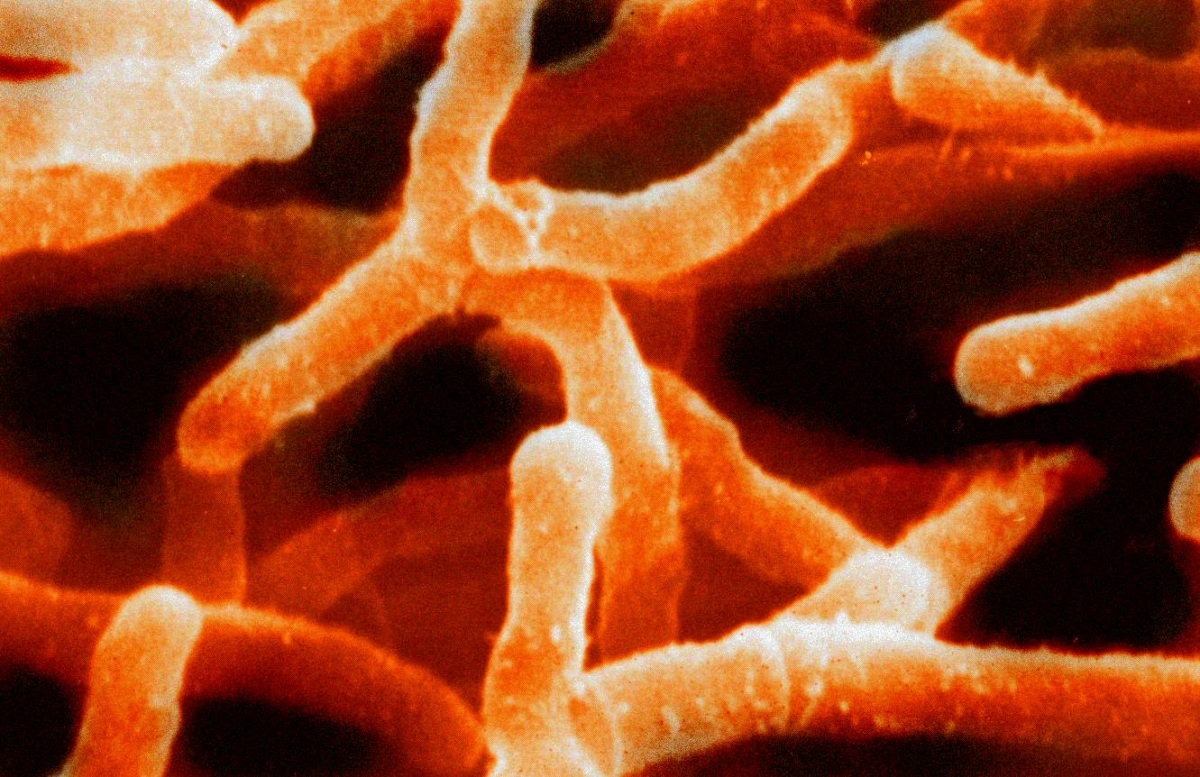
Soils
are one of the largest reservoirs of microbial diversity on Earth. It
is not uncommon for a gram of soil to contain one trillion cells and ten
thousand species of bacteria, including Actinomyces israeli.
GrahamColm at English Wikipedia
The study, published by in the Proceedings of the National Academy of Sciences (PNAS), is based on an intersection and analysis of microbial, plant and animal community datasets – the largest compilation of species data of this kind ever created so far.
Estimating the exact number of species on Earth is one of
the great challenges in biology, and here, the scientists try to put in
practice new technologies to get a more precise idea of the number of
microbial species in existence. These forms of life, which include
bacteria, are too small to be seen with the naked eye but could account
for most the undiscovered species.
"Until recently, we've lacked the tools to truly estimate
the number of microbial species in the natural environment," lead author
Jay T Lennon says. "The advent of new genetic sequencing technology
provides an unprecedented large pool of new information."
20 orders of magnitude greater
The scientists, from Indiana University, combined 20,376 sampling efforts and genetic sequencing of bacteria, archaea and microscopic fungi, as well as 14,862 sampling efforts on communities of trees, birds and mammals.Their analysis of the data reveals that samples contain much more species than previously thought, and that t
he number of species in a sample scales with the area of a landscape. The researchers
document this universal scaling law in their study and say it predicts that about a trillion species could inhabit the Earth.
"Older estimates were
based on efforts that dramatically under-sampled the diversity of
micro-organisms," Lennon points out. "Before high-throughput sequencing,
scientists would characterize diversity based on 100 individuals, when
we know that a gram of soil contains up to a billion organisms, and the
total number on Earth is over 20 orders of magnitude greater."
The scientists also
point out that so far, only one-thousandth of 1% of these species has
been identified, and hope their work can lead to future discoveries.
Post a Comment